National
PANDEF Proposes Niger Delta Infrastructure and Development Fund to Drive Regional Transformation

By Chukwunonso Eric, Warri.
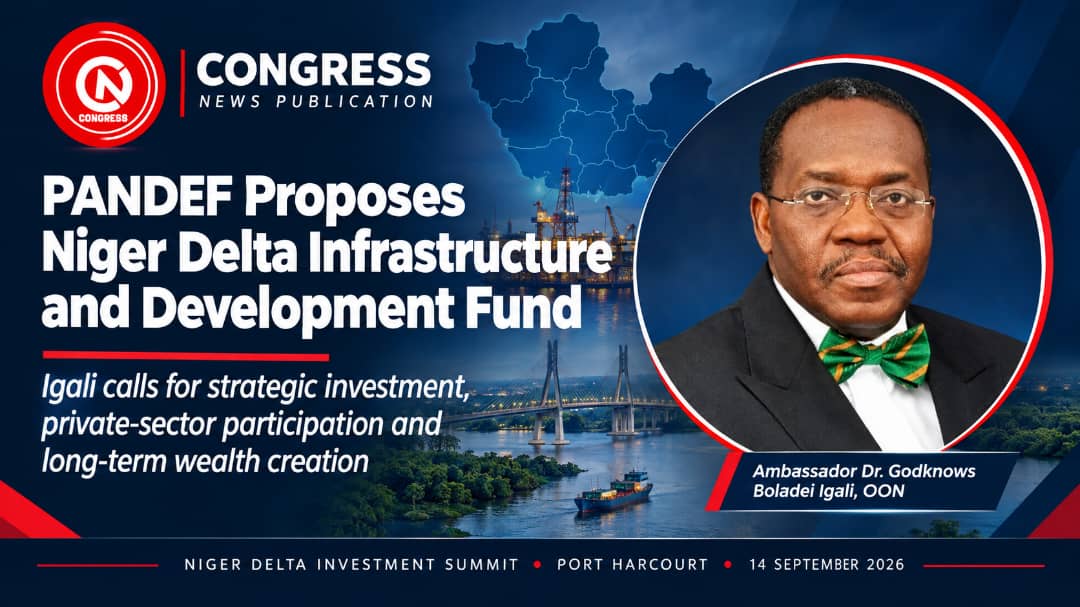
PORT HARCOURT, Rivers State — The National Chairman of the Pan-Niger Delta Forum (PANDEF), Ambassador Dr. Godknows Boladei Igali, OON, has unveiled the proposed Niger Delta Infrastructure and Development Fund (NDIDF) as a strategic initiative to mobilise long-term capital for infrastructure, investment and sustainable economic development across the region.
Igali made the proposal on Monday, September 14, 2026, at the Niger Delta Investment Summit in Port Harcourt, where he called for a shift from dependence on statutory allocations and oil revenues toward deliberate investment, production and long-term wealth creation.
According to the PANDEF chairman, successive government interventions, including statutory allocations, derivation-based transfers and development programmes, have contributed to the region’s development but have not produced the scale of infrastructure and economic transformation required. He noted that the Niger Delta remains heavily associated with crude oil despite its considerable potential in agriculture, fisheries, aquaculture, tourism, maritime activities, manufacturing, energy and technology.
Igali said the proposed NDIDF would serve as a professionally governed, capital-market-anchored financing vehicle, designed to mobilise domestic and international capital for carefully selected, bankable and transformational projects.
The proposed fund would operate as a blended-finance platform, bringing together resources from Niger Delta communities, multinational partners, diaspora investors and the capital market. Projects would be selected through transparent and professionally validated processes, with mechanisms designed to ensure that funds raised are traceable and directed toward projects capable of creating lasting regional value.
He stressed that the NDIDF would complement rather than replace existing development institutions, with the objective of attracting private-sector capital and accelerating infrastructure delivery. Igali also argued that Nigeria’s constrained public finances make it necessary to develop alternative mechanisms for mobilising investment capital.
Addressing concerns over implementation, the PANDEF chairman said extensive consultations had already been held with private-sector stakeholders and members of the Niger Delta diaspora, while the proposal had also been presented to the South-South Governors’ Forum. He expressed appreciation to the Director-General and Chief Executive Officer of the Securities and Exchange Commission, Dr. Emomotimi Agama, for his support for efforts to deepen Nigeria’s capital market and mobilise long-term investment.
On governance, Igali said the fund would be established through appropriate legal instruments and managed by a Board of Trustees comprising representatives of relevant stakeholder groups, while professional fund managers would be selected based on competence, integrity, experience and proven capacity. The private sector, he added, would play the leading role in the investment and commercial aspects of the initiative.
As part of the next steps, PANDEF plans to convene a high-level stakeholder dinner before the end of 2026 in Lagos, Port Harcourt or Abuja. The engagement is expected to facilitate the formation of an advisory committee before the completion of the legal and preparatory requirements for the formal establishment of the fund.
Igali called on governments, private-sector organisations, traditional institutions, development partners, diaspora communities and residents of the Niger Delta to participate in the initiative.
He emphasised the need for the region to move “from dependence to investment” and “from consumption to production,” arguing that the wealth generated from the Niger Delta’s resources should be converted into productive assets, institutions and opportunities capable of benefiting future generations.
The PANDEF chairman described the proposed fund as more than a financial mechanism, saying it represents an opportunity to promote a new culture of investment, partnership and long-term economic planning in the Niger Delta.