National
Driven From the Forest by War, Elephants Roam Into Borno’s Border Towns

By: Adamu Aliyu Ngulde
As insurgency emptied Nigeria’s Sambisa Forest of safety, hundreds of elephants have wandered into communities along the Nigeria–Cameroon border, destroying farms and homes and exposing a quieter but profound cost of conflict.
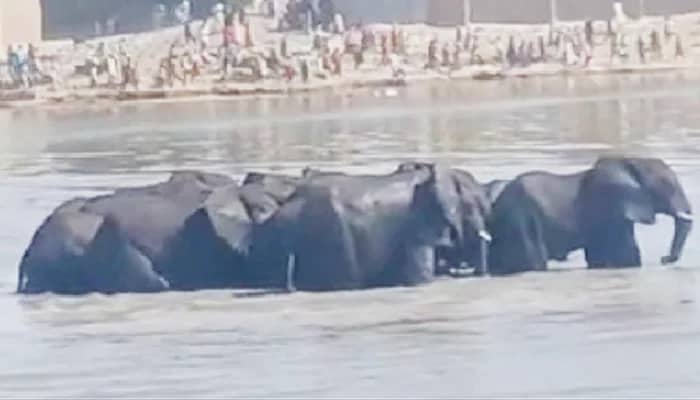
Hundreds of elephants displaced from the Sambisa Forest in northeastern Nigeria have been roaming across border communities in Borno State and into neighboring Cameroon, trampling farmland and damaging homes as they search for food, water and safety, residents and officials say.
The elephants, once sheltered in the Sambisa Forest reserve, were forced out after Boko Haram insurgents seized the area and turned it into a base for attacks across the Lake Chad region.
With their habitat overtaken by violence, the animals now move repeatedly between Gamboru, a border town in Borno State, and Fotokol, just across the frontier in Cameroon.
Gamboru lies about 123 kilometers southeast of Maiduguri, the Borno State capital, near what was once a protected game reserve.
That reserve later became notorious as a stronghold for insurgents, symbolizing how a conflict that began in 2009 has reshaped both human and natural landscapes.
For more than a decade, Boko Haram’s campaign has devastated communities across northeastern Nigeria, killing tens of thousands of people and displacing millions.
The humanitarian crisis is among the worst in Africa. Less visible, but no less severe, has been the damage to ecosystems that once sustained wildlife.
Sambisa Forest, long known for its biodiversity and as a refuge for elephants, antelopes and other species, became inaccessible to conservation workers as violence spread. Poaching increased, monitoring collapsed and animals were left to fend for themselves. Deprived of safe habitat, elephants began to migrate toward populated areas, intensifying human–wildlife conflict.
In towns like Gamboru and Fotokol, residents say the animals regularly stray into farms and residential neighborhoods, destroying crops, homes and other property.
One such incident occurred on Thursday, Dec. 4, 2025, at about 2 p.m., according to residents, who described it as part of a recurring pattern that has persisted for years.
Borno State officials say the elephants belong to the state and that their displacement is a direct consequence of the prolonged insurgency.
Ali Abatcha, the general manager of Sanda Kyarimi Park, a state-owned wildlife zoo, said emergency measures had been put in place to contain the animals and protect communities.
“Those animals are our property. They are from Sambisa Forest,” Mr. Abatcha said. “They migrated to Ngala and have been moving between Nigeria and Cameroon after suffering displacement years ago in the Sambisa reserve.”
He said an emergency meeting had been convened and that the state’s elephant control unit had been activated. Personnel, he added, were being mobilized to prevent the elephants from entering towns and causing further destruction.
In some cases, young elephants would be tranquilized and transported to Maiduguri.
Accurate data on the elephant population remains difficult to obtain, Mr. Abatcha said, because insecurity halted proper surveys.
Estimates suggest there are more than 300 elephants, spread across three family groups, though officials acknowledge the figures may not be precise.
The wandering elephants have become an emblem of the conflict’s indirect toll — a reminder that war displaces not only people but also wildlife, forcing dangerous encounters in already fragile communities.
Conservationists and local officials say the situation underscores the need for coordinated, cross-border management efforts to protect both civilians and animals in a region still struggling to emerge from years of violence.