National
The Pull of Amaseikumor Festival

By: Enewaridideke Ekanpou
April is the herald of the famous Amaseikumor masquerade festival in Gbaramatu Kingdom in Warri South-West Local Government Area of Delta State. The heraldic designation of April is occasioned by the yearly celebration of Amaseikumor Festival from 6 April to 11 April of every year as it has just been remarkably witnessed this 2026 through a panoply of cultural and mystical activities ritualistically programmed and followed religiously without deviation.
It is a vivaciously cultural and social week-long celebration that usually ends on the morning of the twelfth day. It is also a vivifying mystically significant event that centres on the codes and algorithms of mysticism rooted in opening the space for spiritual harmony to flow unceasingly between the people and the gods. Towards the attainment of the envisioned spiritual balance and harmony between the people and the gods in a sacred relationship ritualistically mediated by High Chief Dr.(h.c.) Government Oweizide Ekpemupolo (Tompolo) and his mystically rooted core believers and traditionalists that religiously follow the algorithms and codes of traditional mysticism, a week-long period of abstinence from sex and any other allied forms of impurities is a sacrosanct mystical observance and law while the celebratory activities last.
Viewed and framed theologically, philosophically, traditionally and mystically as a god of wealth antagonistic to anything that would bring impurities, dangers and problems to Gbaramatu Kingdom, nay, Ijaw nation and Nigeria, the celebratory activities of Amaseikumor Festival command varied perspectives. These varied perspectives stem from the cultural, traditional, social and mystical algorithms which drive the progression of the celebratory activities from the genesis to the revelation when the head Amaseikumor masquerade and his retinue of beautifully attired masquerades appear and disappear with solemn dignity, having culturally and mystically achieved the designated purpose within seven days that hark back to the seven steps/rungs on the mystical ladder stationed mystically over the waterfront for accomplishment of mystical work associated with Amaseikumor Festival.
Rather than for vacuous mundane inclinations and reasons, Amaseikumor is yearly celebrated for heightened spirituality and harmony with the positive constructive forces exemplified by Egbesu, Barugu and their spiritual allies. Ritualistically heightened spirituality and harmony is the traditional Holy Grail required to wipe out all the behavioural miasma and impurities on the land and pave the way for the flow of the ozone of prodigious wealth traditionally associated with Amaseikumor celebration. Pragmatic physicalisation of the prodigious wealth and generosity associated with the Amaseikumor masquerade is the amazing dedicated feeding, transportation and accommodation of all the various communities that grace the celebration, accompanied by cash gifts to all participants, putting on their faces radiant smiles in their homeward journey after all the celebrations.
A captivating week-long celebration it is for Amaseikumor Festival, 6 April to 10 April is dedicated chiefly to ritualistically followed traditional sacraments within the precincts of the sacred temples of the gods. Here in these sacred temples only people free of sexual engagements and other impurities of the mind and body are allowed to participate in its culturally ritualistic activities geared towards strengthening harmonious spiritual relationship with the gods and the cosmic for endless cascade of benediction from the positive constructive forces. At this sacred level of the celebration of the ritualistically anchored traditional sacraments at the sacred temples that simply demand purity, electrifying elements of culture and tourism could be detected and enjoyed by all purified visitors. The human beings and the different trees clothed in pure white colours with strips of white bands beautifully tied on their heads tell all that culture and mysticism are congruently in their best mix or willing marriage. At this moment of vivacity with High Chief Tompolo seated vertically at a designated left corner on the entrance to the sacred temple, directing ritualistically with his mobile hand-fan, drummers, singers and dancers are seen at the best of their various talents. From time to time Tompolo nimbly deserts his vertical seat with dignifying dance steps, plants himself right before the drummers and singers and signals a change of songs. Immediately more spiritually inspiring antiphonies are worked out for the drummers and the dancers to key into correspondingly with their percussionist and dancing skills.
Drums skillfully at a crescendo accompanied by the antiphonies, Tompolo could be seen dancing ‘yenkeyenken’ with his hand-fan skillfully waved both horizontally and vertically while he dramatically takes two steps forward and movingly maintains ‘yenkeyen’ motion on one spot.
The ritualistically directed dancing is usually acted out in two orderly processions while the drummers and the singers occupy their designated space from which the vivaciously beaten drums and the thematically relevant antiphonies invade the earth and pierce the sky in a language translated into amazing ‘agene’ dance steps by the dancers in the two processions. All participants in the high-spirited sacramental engagement in the sacred temple communicate with drums, songs and dance steps; they are equally treated to ambrosia deliciously prepared from the slaughtered animals.
The gathering of the participants on the tenth day of April to partake of the ambrosia believed to carry fortification in all spheres of life is like the gathering for the last supper in the Bible.
The ambrosia is the last sacrament ritualistically engaged in the sacred temple before the Amaseikumor celebration moves progressively to the grand finale on the eleventh day of April when social, cultural and mystical dimensions are meaningfully combined for dignitaries from all walks of life to enjoy culture and tourism at their best without interrogative murmuring and gestures quizzically written on their faces. This is the moment great musicians like Professor Izonebi Alfred, Chief Kingsley Takemebo and many others captivate visitors with memorable hits from their repertoire of songs.
The mysticism ritualistically built around Amaseikumor Festival by Tompolo as a heritage from past generations sheds itself of the major component which exists more in tokenism and symbolism after the ambrosia sacrament in the sacred temple when the celebration shifts to a bigger public space used by both secular artistes and marketers of culture across the globe. Comfortably from a broad perspective it is conceded that Amaseikumor Festival celebrates the virtues of cultural purity, liturgical purity, spiritual purity, marital purity, moral purity, traditional purity, philosophical purity, communal purity and philanthropic purity.
A survey of all the activities associated with Amaseikumor celebration, particularly, within the sacred temples where traditional sacraments are ritualistically carried out, a singleminded race to guarantee the sanctity of these highlighted virtues is the necleus of the whole celebratory exercise.The sanctity of these virtues is the road to healthy relationship and harmony between the people and the gods. Roses on the life of man wilt when this road to the gods is clogged by man-made impurities. This is why Tompolo strives to bridge this yawning gap with his radiant traditional mysticism and culture that is characterised by sensitivity to the plight of the ordinary people as his own philosophical substratum.
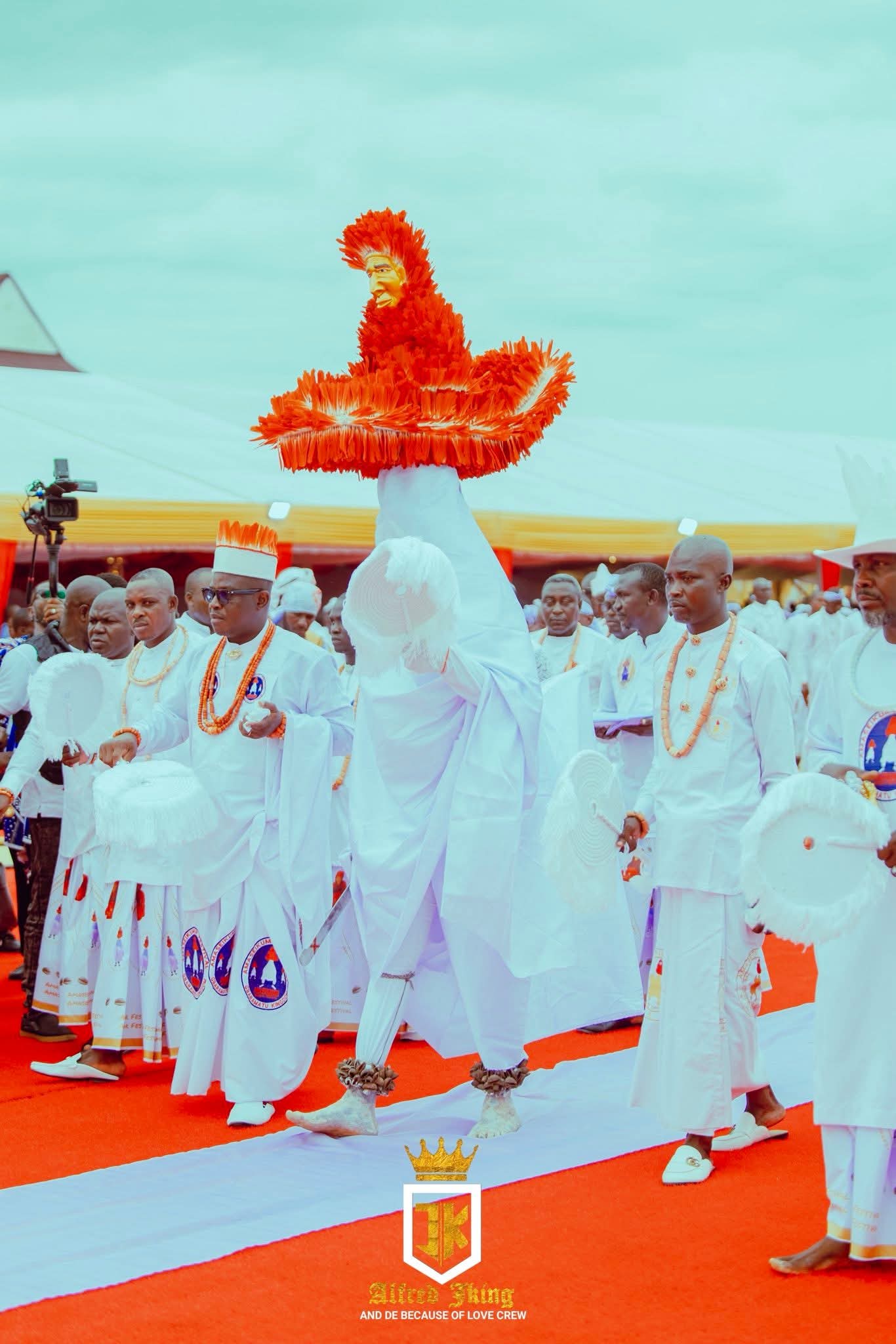
The eleventh and the twelfth days of Amaseikumor Festival are memorable days on the quasi-social dimensions of the celebration.On the eleventh day of April when all the visitors from far and wide are seated on the arena for the celebration, Amaseikumor and a retinue of beautifully clothed masquerades walk into the arena with calculated dignified steps in the centre of two processions. All the men in these processions wear white clothes that mesh colourfully with the masquerades in their dignified appearance. The masquerades and the two processions are led into the arena by Tompolo who wears radiant white clothes, holding a white hand-fan which occasionally waves appreciatively to all visitors. The dignified walk of Tompolo, the masquerades and the two processions take them round the arena. In the midst of this dignified walk, drummers and singers are at their best as they pierce the sky with drums and voices rhythmically striking to all the gathered whose heads nod compulsively at intervals.
No sooner the dignified walk ends than the masquerades captivate spectators with their dancing. Spectators are mesmerised by how the masquerades dance gracefully and skillfully strike the rattles on their legs with accuracy even with their eyes cast sideways, using their bamboo ‘ogidi’ held. Cyclically the masquerades circle the arena in their striking dance accompanied by striking of their leg rattles. These activities of the masquerades are interspersed with secular entertainments from cultural troupes and music from live bands stationed on the arena.
In equally dignified manner, Tompolo leads Amaseikumor , the masquerades and the two processions back to the sacred world from which they emerge after all the mesmerising performances on the arena during the daytime. At night music from live bands keep all spellbound with timeless songs. At dawn all the visitors that grace the occasion are categorised into their different communities of origin and presented with cash gifts; their boats are also fuelled for their homeward journeys. Amaseikumor the god of wealth and bounties lives up to his billing when Tompolo becomes the physicalised version of Amaseikumor through his undiscriminated generous cash offerings to all visitors towards the facilitation of their homeward journey to their various communities of origin. On the physical plane High Chief Tompolo is the Amaseikumor because he is the canoe for the bounties associated with Amaseikumor. At the visible level the world knows no pull and pivot other than the mystic called Tompolo whose thoughts and deeds reflect the cardinal virtues of Amaseikumor.
Dr. Ekanpou writes from Akparemogbene, Delta State.