National
Ernest Ikoli Foundation Hails Late Nationalist as Deep Thinker, Liberator of the People

By Chukwunonso Eric, Warri.
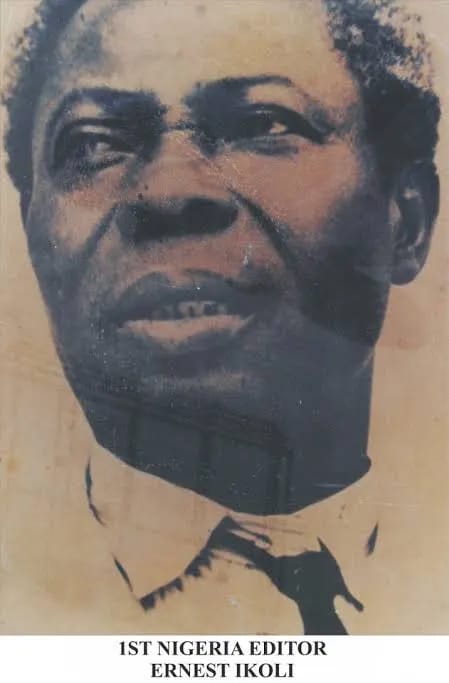
The Ernest Ikoli Foundation has described late Nigerian nationalist, journalist, educationist and politician, Chief Ernest Sesei Ikoli, as a deep thinker and liberator of the people whose contributions helped shape Nigeria’s nationalist movement and early political development.
The foundation, in a statement titled “The Life and Times of Ernest Sesei Ikoli,” praised the late nationalist for promoting unity among Nigeria’s diverse ethnic groups and providing an organisational foundation for the struggle for self-government and independence.
Signed by the Vice Chairman of the foundation, Chief Anthony George Ikoli, SAN, the statement said Ernest Ikoli believed that unity among Nigerians was essential to confronting colonial rule and advancing the interests of the people.
The foundation highlighted Ikoli’s entry into institutional politics, noting that he represented Lagos in the colonial Legislative Council after winning election in 1941 on the platform of the Nigerian Youth Movement (NYM). He was subsequently elected President of the NYM in 1943 and returned to the Legislative Council in 1946, where he advocated open government, improved working conditions and broader political representation for Nigerians.
It described Ikoli as one of the most intellectually distinguished Nigerian politicians of the colonial era, as well as an energetic campaigner against racial discrimination and injustice.
According to the foundation, Ikoli played a significant role in bringing educated Nigerians from different ethnic backgrounds together to demand self-government and educational reforms. His advocacy, it said, helped advance social and political consciousness at a critical period in Nigeria’s history.
The foundation also recalled his confrontation with racial discrimination at King’s College, Lagos, which eventually contributed to his resignation from the institution after an incident involving what he regarded as racial arrogance and disrespect from a European teacher.
Born on March 25, 1893, in Brass, present-day Bayelsa State, Ikoli attended Bonny Primary School before becoming one of the pioneer students of King’s College, Lagos, when it opened in 1909. He later served as an assistant mathematics teacher.
His journalism career became a major platform for his nationalist activities. After working with the Lagos Weekly Record, he founded the African Messenger in 1921, using its editorials to challenge colonial policies. In 1926, he became the first African editor of the Daily Times of Nigeria and later edited The Daily Service.
Beyond journalism, Ikoli was involved in several political and nationalist organisations. He served as Nigerian organising secretary of Marcus Garvey’s Universal Negro Improvement Association (UNIA), bringing Pan-African ideas into Nigeria’s political discourse. He was also President of the Nigerian Youth Movement, Secretary of the People’s Union led by Dr. J.K. Randle, and co-founder of the Union of Young Nigerians in 1923. In 1951, he collaborated with other nationalist leaders in the formation of the Action Group.
The foundation further credited Ikoli with contributing to the establishment of the Daily Times, serving as Chairman of the Rediffusion Service and working as a public relations adviser to the Nigeria Railway Corporation.
Describing him as a patriot, a liberator and an example of steadfastness in the pursuit of the common good, the foundation urged contemporary leaders in Nigeria and around the world to emulate his virtues of courage, discipline, fairness, humility, hard work, thoroughness and commitment to public service.
Ernest Sesei Ikoli died on October 21, 1960, barely three weeks after Nigeria attained independence from Britain, leaving behind a legacy of journalism, nationalism, political organisation and advocacy for unity and self-determination.