National
FAP Model Gives Married Women Second Chance At School As Dangote’s Daughter’s Foundation Steps In

By Abdullahi Alhassan, Kaduna
A new education programme in Kaduna is daring a long-held social norm that pushes married women out of classrooms and into the kitchen. Under the Rebound Initiative for Young Women, hundreds of women aged 15 to 30 who dropped out after marriage are being given flexible classes, free books and a path back to formal learning.
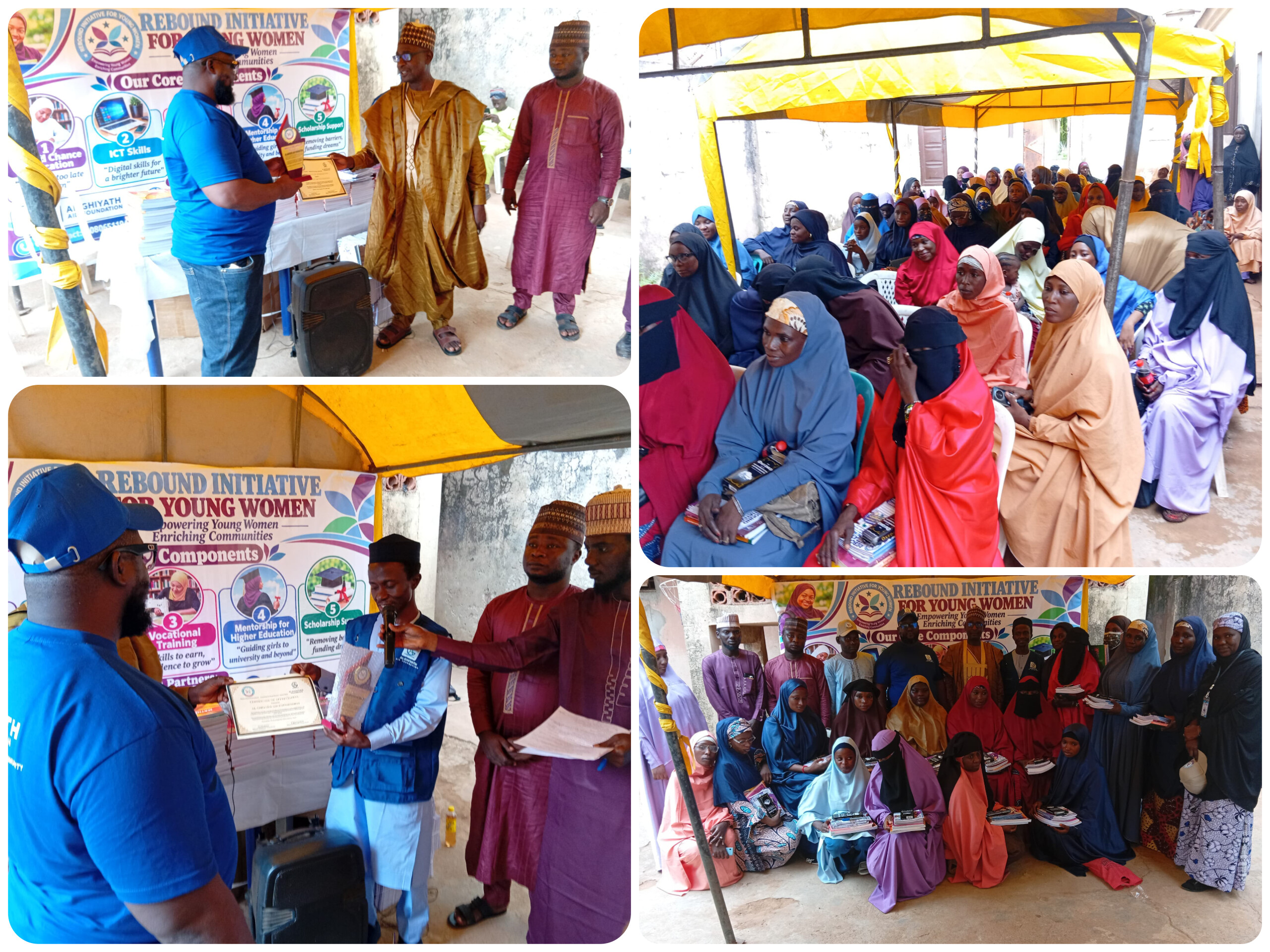
The effort got a major boost this week as the Al-Ghiyath Aid Foundation, founded by Mariya Aliko Dangote, made its debut donation of textbooks, writing materials and biro to 90 beneficiaries at a Rebound learning centre. It is the foundation’s first major intervention since registration.
Rebound officials say the model was built around three realities that keep women out of school: time, cost and distance. They call it the ‘FAP’ model. Flexible class times of about three hours, two to three times a week. Affordable learning through free tuition and packs. And Proximity, with centres sited within walking distance so mothers do not have to spend on transport or leave children for long.
Mallam Musa Abdullahi, Chairman of Rebound Initiative, said the goal is to break the cycle that equates a woman’s role only with the home. “We are fully aware that one of the challenges our society is facing is the social norm that says women should only belong to the kitchen,” he said. “A lot of them are brilliant, they are bright. If they should be given the opportunity, they will rise to the sky.”
The partnership with Al-Ghiyath came together quickly, according to Abdullahi. “When we knocked at the door of Al-Ghiyath, they did not waste time, they opened the door,” he said. “We told them this is what we are doing, and these are what we need. And quickly, they approved, and they responded by providing, and that is what you see us distributing to the learners today.”
For Al-Ghiyath, the donation marks the start of a wider agenda. Ibrahim Mamman Sani, a pioneer member of the foundation and staff of Dangote Sugar Refinery, said the gesture fits into its education and empowerment pillar. “The founder of Rebound is a friend. He knows my ability, he knows my connection, so he has been pestering me: ‘How do we assist?’ We said let’s start with this first,” Sani said.
He explained that the foundation covered the full cost after a delay caused by not having a corporate account. “Hajia Mariya quickly opened that account, and that transfer was made from there,” he added. The foundation’s website is still under construction.
Sani outlined four areas that will define Al-Ghiyath’s work. First is basic needs, including food and shelter during disasters. Second is medical support through partnerships. Third is education and empowerment, with focus on girls’ education and skills that lead to independence. Fourth is community partnership for orphans and widows.
The motivation, he said, is simple and personal. “It’s just to give back to the society, because you never can tell. Most of us got some assistance from nowhere, but it’s because of the good things our parents have also done,” Sani said. He cited a teaching of the Prophet (SAW) on the lasting reward of knowledge, and argued that successful people must be remembered for service.
Continuity will matter more than one-off gifts, according to the foundation. “The aim of the foundation is sustainability. We don’t want it to cut off. Continuity is the most important thing,” Sani said. More programmes across the four pillars are expected in the coming months.
Rebound is not stopping at literacy. From January, beneficiaries will enter three months of basic computer training. That will be followed by skill acquisition in knitting, weaving, pomade making and other trades, with starter tools given to graduates.
The last stage is designed to push women into higher education. Rebound has already secured partnerships with institutions including Kaduna State University satellite centres to support diploma and NCE programmes. “We are not just giving second-chance education,” Abdullahi said. “Our target is that after knowledge and skills, she will continue to go to school from her pocket. She wouldn’t rely on husband or any sponsor to sponsor her.”
For the students, the books made an immediate difference. Maimuna Rabiu, one of the beneficiaries, said she can now revise at home and retain what is taught in class. “Today we were given free books. We are grateful. May God reward them with goodness and bring even greater things,” she said. “It will help me expand my knowledge. Also, I won’t forget the things taught at school because I can take them out and read them at home.”
The school community thanked both organisations and urged more support to reach every student in need. With Al-Ghiyath’s entry and Rebound’s FAP structure, organisers say the aim is clear: move women from dependency to self-reliance, one classroom at a time.