National
ECOLOGICAL THREAT: GBEKEBOR ON THE EDGE; A COMMUNITY SLIDING INTO THE RIVER

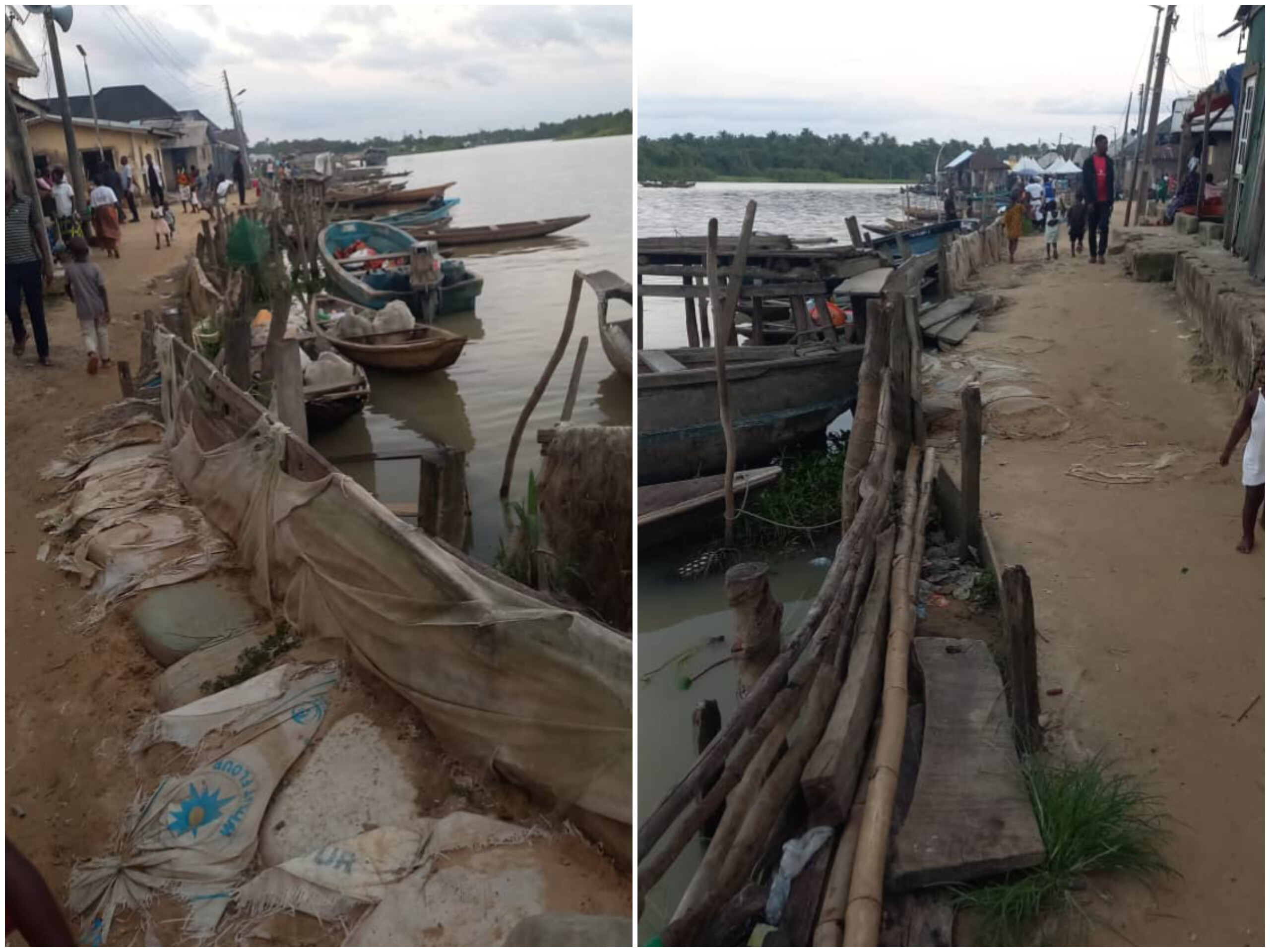
“An Urgent Call for Intervention as Erosion, Sedimentation and Flood Threat Converge”
By Engr. Yeigagha Henry, JP
Gbekebor is no longer at risk; it is already in crisis. What was once a stable riverine settlement is now steadily collapsing into the river. The rate of shoreline retreat has accelerated to a dangerous level, and the threat is no longer distant or theoretical. It is immediate, visible, and devastating.
Today, frontline houses in Gbekebor stand barely a metre away from being swallowed by the river. Several homes have already been lost. Others hang precariously, their foundations weakened by continuous undercutting from aggressive river currents. With every passing day, the shoreline gives way, and the community inches closer to irreversible destruction.
This is not ordinary erosion. It is the result of altered river behaviour driven by sedimentation and channel distortion. Over the years, heavy deposits of alluvial materials have reshaped the river system. What was once an open and active channel in front of Gbekebor has gradually transformed into a landmass; now perceived as an island.
This obstruction has disrupted the natural flow path of the river. Instead of flowing freely through its original course, the current has been forced to redirect its energy toward the community’s shoreline. The result is concentrated hydraulic attack; continuous scouring, bank failure, and eventual collapse of adjoining structures. Simply put, the river has changed course; and Gbekebor is now in its path.
The community has not been idle. Local efforts, driven by limited resources, have attempted to slow the damage. But these are temporary measures; far from the scale required to address a problem rooted in large-scale river dynamics. This crisis has clearly outgrown community intervention. Behind the physical destruction lies a deeper human tragedy.
The people of Gbekebor are crying in silence. Children and youths no longer have safe spaces to play. Open grounds that once served as communal and recreational areas have disappeared beneath advancing waters. Homes that once provided comfort and security are now unsafe for habitation. Families live with daily uncertainty, unsure whether the next rainfall or rise in water level will claim what remains of their homes.
What we are witnessing is not just environmental degradation; it is the slow displacement of a people.
The river current now moves with a frightening intensity, carving through land with destructive force. It is no exaggeration to say that it behaves like a system set on a path to destroy everything in its reach.
This situation is no longer a matter for debate. It is an emergency. Urgent and coordinated intervention is required. The solution must include: strategic dredging to remove obstructing sediments and restore the river’s natural channel, engineered shoreline protection, including piling and revetment systems, sand filling and land reclamation to recover lost ground and stabilize the community edge, and beyond technical measures, there must be immediate institutional response.
The Niger Delta Development Commission and the Delta State Oil Producing Areas Development Commission must move swiftly to assess and intervene. The leadership of Sheriff Oborevwori must treat this as a priority environmental emergency.
Political leaders, including the Chairman of Burutu Local Government, must not ignore what is clearly a ticking time bomb.
There is also a strong call to respected Ijaw leaders such as Government Ekpemupolo, Mathew Tonlagha, Pondi, Guwor, Otuaro, just to mention a few whose influence and voice can mobilize urgent attention. The Ijaw Youth Council and the Ijaw National Congress must immediately engage relevant authorities and drive coordinated advocacy for intervention.
Time is no longer on Gbekebor’s side. The perennial flood season is fast approaching, bringing with it the familiar threat of widespread devastation. If urgent action is not taken, Gbekebor could be partially, or completely, sacked in the coming months.
This is not alarmism. It is a clear warning based on present realities. The moment calls for action, not tomorrow, not after another assessment, but now. Let all stakeholders arise. Let the solution begin.